Slider

Freedom Opera Gala

Sunday, September 7, 2014

Part of the Andrássy út was closed yesterday. Obviously something was going to happened there. Loads of chairs and a stage was built in the front of the Opera House.

Not sure if it was rehearsal or just for fun for the passers-by. Very entertaining anyway!


Seems like everything is ready for the evening.


It was exactly 25 years ago since Hungary opened its borders and allowed tens of thousands of East Germans to escape. This event was remembered by the Freedom Opera Gala featuring Anja Kampe, Piotr Beczala, Ferrccio Furlanetto and internationally acclaimed Hungarian soprano, Andrea Rost. Beside the four special guest stars, young singers and conductors of several European nations appeared on stage to sing of freedom and famous ensembles. 

The programme:

1. Kodály: Dances of Galánta 
2. Beethoven: Fidelio - Leonore's aria (Anja KAMPE)
3. Beethoven: Fidelio - Choir of prisoners (Hungarian State Opera Choir)
4. Verdi: Un ballo in maschera - Riccardo's Aria, act III (Piotr BECZAŁA)
5. Tchaikovsky: Onegin - Gremin's Aria (Ferruccio FURLANETTO)
6. Verdi: Rigoletto - Quartet (Péter BALCZÓ, Alena KROPACKOVA, Tomasz KUMIĘGA, Zita SZEMERE; conducted by Patrick HAHN)
7. Erkel: Bánk bán - Melinda's Aria from act II (Andrea ROST)
8. Verdi: Don Carlo - Duet (Piotr BECZAŁA, Mihály KÁLMÁNDI)
9. Verdi: Don Carlo - Duet (Ferruccio FURLANETTO, Mihály KÁLMÁNDI)
10. Wagner: Tristan und Isolde - Liebestod / Eagling: Duet (Anja KAMPE, Lili FELMÉRY, Evgeny LAGUNOV)
11. Verdi: Nabucco - Choir of slaves (Hungarian State Opera Choir)
12. Verdi: Nabucco - Pray of Zacharias (Ferruccio FURLANETTO)
13. Lehár: Giuditta - "Freund, das Leben ist?" (Piotr BECZAŁA)
14. Lehár: Die lustige Witwe - Vilja song (Andrea ROST)
15. Verdi: Falstaff - Fugue (Péter BALCZÓ, Mojca BITENC, Géza GÁBOR, Tamás KÓBOR, Leon KOŠAVIĆ, Nikos KOTENIDIS, Zoltán MEGYESI, Gemma NÍ BHRIAIN, Violette POLCHI, Sara ROSSINI; conducted by Pierre DUMOUSSAUD)


The happening was supposed to start at 8pm. Light rain showers started at around 7pm and a couple of minutes after 8pm, it was announced that the whole gala will be moved inside the opera house... you can imagine the massive amount of people rushing inside! Couldn't handle it, so skipped the occasion. Anyway the atmosphere would have been totally different inside, I guess. Probably took at least another hour to organize everything ready again and don't think the light installation show took place at all.


There was supposed to be fireworks afterwards, as i was already fasten sleep didn't see nor hear anything. 

Osa Andrássy út:a oli eilen suljettu ja oopperan edustalle oli rakennettu esiintymislava ja aseteltu mieletön määrä tuoleja. Illalla klo 20 oli määrä alkaa Freedom Opera Gala. Oli kulunut 25 vuotta siitä, kun Unkari aukaisi rajat kymmenille tuhansille itäsaksalaisille. Gala järjestettiin tapahtuman muistoksi ja esiintyjälistalta löytyi mm. Unkarin ylpeys sopraano Andra Rost. 
Taivaalta alkoi ripotella pieniä kuuroja siinä seitsemän aikaan illalla ja muutaman minuutin yli klo 20, jolloin konsertin piti alkaa, ilmoitettiin, että se siirretäänkin oopperan sisätiloihin... Arvaahan sen, että siitä syntyi massiivinen kaaoksenomainen ryntäys. Päätin jättää väliin. Tunnelma sisällä tuskin oli sama kuin mitä se olisi ollut ulkona upeine valoinstallaatioineen. Toivotaan, että kaikki meni hyvin ja ilta oli onnistunut.
Galan lopuksi taivaalle lähetettyjä ilotulitusraketteja en nähnyt enkä kuullut, sillä olin siihenaikaan jo kotona syvässä unessa.


Mefistofele

Tuesday, January 24, 2012


Mefistofele is an opera in a prologue, 
four acts and an epilogue, 
the only completed opera by the Italian 
composer-librettistArrigo Boito.

Mefistofele premiered on 5 March 1868 at La Scala in Milan.
At the time the opera was too avant-garde to the audience
and it turn out to be a fiasco.

Later it has been performed in all great opera houses.
Maria Callas has played the role of Margherita in 1958.
In the clip the part of Margherita is played by 
Hungarian Eva Marton.

The opera including the settings is quite
an experience - a real spectacle.
(unfortunately no pics of it!)
Absolutely worth seeing!

On Saturday the roles were:
Mefistofele - Gabor Bretz
Faust - Attila Fekete
- fantastic!
Margherita - Gabriella Kiss Letay
- fabulous!
Wagner - Gergely Boncser
Marta - Eva Panczel

Liszt

Sunday, September 4, 2011

 Proper dinner at home:
Cold-smoked salmon filled with shrimp salad on a slice of bread

 Pasta gambaretti

 Hungarian "szurke marha"
fillet of beef with Brussels sprout

Wines:
Pouilly-Fume 2009
Thummerer Egri cabernet sauvignon 2006
(bought a box of it in their cellar last Sunday)

Music:
Edit Piaf
- Liszt will come later

After the dinner
- which was not so small -
went for a little walk
to the opera house
 Earlier this week had received an invitation
for a Franz Liszt concert
in the front of the opera house
- the invitaion came from Terezvaros (= 6.district of Budapest)
Franz Liszt was a 19th-century Hungarian composer,
virtuoso pianist, conductor, and teacher.

 Gergely Boganyi gave a marvellous piano concert
playing Liszt Ferenc (= Franz Liszt)

He Gergely Boganyi was born in 1974 in Vác, Hungary,
and started playing the piano at the age of four.
The family moved from Hungary to Finland
when Gergely was 14 years old,
so he speaks fluent Finnish.
 He continued his studies at the Liszt Academy in Budapest,
the Sibelius Academy in Helsinki and
at Indiana University in Bloomington with professors
László Baranyay, György Sebök, Matti Raekallio.

Beautiful warm night on Andrassy ut
It's fantastic that the city organizers this kind of concerts!

Norma

Monday, October 4, 2010


"Casta Diva"
The grand finale of the cultural week was
Bellini's Norma at the National Opera in Budapest
on Sunday evening

Szilvia Rálik as Norma
- beautiful voice but perhaps more suitable for Wagner
Good production!
- the tragic story is happening around 50BC near Roma
http://www.opera.hu/

Der Rosenkavalier

Friday, October 1, 2010

Wednesday was an opera night
with mom & auntie
.
Der Rosenkavalier (The Knight of the Rose) is
a comic opera in three acts by Richard Strauss.
It was first performed at the Königliches Opernhaus
in Dresden on 26 January 1911.
.
The opera is quite long, 4,5h with 2 intervalls
- the stage was a bit contemporary
as can be seen in the photo
- the Marschallin had a great voice!
Sophies's voice was a bit weak,
but it was told before the performance
that she's been sick
.

Carmen

Friday, June 4, 2010

Had tickets to Georges Bizet's Carmen
for Thursday night
- stalls 2nd row
.
Éva Pánczél as Carmen
- great voice
- always a bit disturbing when
Carmen has put on some weight
and
Don José & Escamillo aren't so very handsome...
.
Anyway, best Carmen production
that've seen in Budapest!
.

Carmen

Monday, March 29, 2010

Had a totally new experience on Saturday
as went to see an opera at a cinema!
At Aréna Plaza's Cinema City
Bizet's Carmen was shown.
Without any expectations
went there open-minded
- opera can be seen alive in a real opera house
or listened on cd,
but watching it in a cinema...
.
It was GREAT,
absolutely fantastic!
The performance was by Royal Opera
in Covent Garden
with excellent singers
who also could act extremely well.
You could get really close to the story,
see it much deeper than on opera stage,
with more details.
.
Highly recommended!
.

La Traviata will be shown
5 times in April
.
ww.cinemaestro.hu
.
"As a musician,
I tell you that if we were to suppress
adultery, fanaticism, crime, evil, the supernatural,
there would no longer be
means of writing one note"
Georges Bizet
(25.10.1838-3.6.1875)
.

Opera House

Monday, December 28, 2009

Went to see La Boheme on Boxing Day evening
- the main 4 singers were good,
but something was missing,
not enough soul in it
.
Mimi - Ilona Tokody
Rodolfo - István Kovácsházi
Musette - Zsuzsanna Fülöp
Marcello - Tamás Busa
.
On Sunday went to see The Nutcracker
- same feeling: everyone was good,
but something was missing
Maria the Princess - Anna Tsygankova
- she was great!
Nutcracker the Prince - Tamás Nagy
.
Pics of the beautiful Opera House in Budapest:

.
Detail of the fabulous ceiling in downstairs
.
Detail of the mosaic floor downstairs
.

Madame Butterfly

Friday, October 2, 2009

Had tickets to the Hungarian State Opera
to see Madame Butterfly
on Thursday night
- sad story,
good production
.
Cio-Cio-San (soprano) - Zsuzsanna Bazsinka
Pinkerton (tenor) - Istvan Kovacshazi
.
Madame Butterfly is hauntingly lyrical opera which,
in its day,
mirrored the West's new interest in Japan.
Puccini himself studied Japanese folk songs and manners
in a bid of authenticity.
But while he borrows some Japanese motifs
and imitates some Japanese melodies,
the music remains Italian.
Unusually, though,
this is a tragedy laced with cruelty.
Only 15 and already a geisha
when she meets Pinkerton,
the purity of her love contrasts fiercely
with the American's predatory cynicism.
This innocence is conveyed in the sumptuous duet
closing Act 1,
the -ever-hopeful "One Fine Day",
and even in the farewell to her child.
Puccini described it as his most
"deeply-felt and imaginative" opera.
.
.

Tosca

Sunday, May 17, 2009

Went to opera to see Tosca with friends on Saturday evening
.

Puccini's Tosca
Floria Tosca - Gyongyi Lukacs/soprano
A prima donna
- very good!
Mario Cavaradossi - Janos Berkes/tenor
Her lover
Baron Scarpia - Bela Perencz/baritone
Police chief of Rome
Angelotti - Peter Fried/bass
a fugitive rebel
Sacristan - Gabor Garday/baritone
Spoletta - Laszlo Haramza/tenor
Scarpia's henchman
Sciarrone - Tamas Clementis
Conductor: Geza Torok
.
After the opera had supper at Callas
.

Mushroom risotto
-delicious!
.
Lot of people came there after the opera, so
they should have a special evening menu,
something rather light to choose after opera, theatre...
.
Callas
Andrassy ut 20.
VI Bp

Il barbiere de Siviglia

Sunday, April 5, 2009

Went to Opera to see the Barber of Seville
at the Operaház on Saturday
.
The curtains were going up & down
during Rossini's beautiful & famous overture
- liked the simple but beautiful setting
.
Count Almaviva, a local nobleman - tenor
Dániel Vadász
Doctor Bartolo, Rosina's guardian - bass
Kázmer Sárkány
Rosina, Bartolo's ward - mezzo-soprano
Yang Li
Figaro, the barber of Seville - baritone
Csaba Szegedi
Basilio, Bartolo's accomplice - bass
Kolos Kováts
Berta, servnt of Bartolo - soprano
Dóra Érsek
Fiorello, The Count's servant - bass
Lajos Geiger
.
Conductor:
Géza Köteles
...
Not bad,
although like more dramatic & tragic operas
than comedy ones
.
The Barber of Seville, or The Useless Precaution
(Il barbiere di Siviglia, ossia L'inutile precauzione)
is an opera buffa in two acts by Gioachino Rossini
with a libretto
(based on Pierre Beaumarchais's comedy Le Barbier de Séville)
by Cesare Sterbini.
The overture, first written for Aureliano in Palmira,
is a famous example of Rossini's characteristic Italian style.
Rossini's opera follows the first of the plays from the Figaro trilogy,
by French playwright
Pierre Augustin Caron de Beaumarchais,
while Mozart's opera Le nozze di Figaro,
composed 30 years earlier in 1786,
is based on the second part of the Beaumarchais trilogy.
The original Beaumarchais version was first performed in 1775,
in Paris.

Beautifully made ceiling at the opera entrance
...


Magnolias on Andrássy út in the garden of Koga House

Il Trovatore

Thursday, March 12, 2009

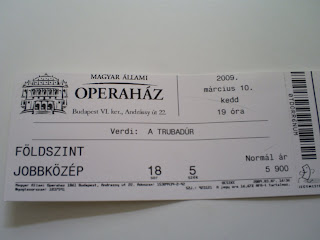
On Tuesday night went to Opera to see Verdi's Il Trovatore
.
Fantastic!
Everyone's voices were perfect!
Casting:
Il Conte di Luna - Fokanov Anatolij (baritone)
Leonora - Farkasréti Mária (soprano)
Azucena - Wiedemann Bernadett (mezzo-soprano)
- excellent!
Manrico (Il Trovatore) - Angelo Simos (tenor)
Ferrando - Palerdi András (bass)
Ines - Markovics Erika (soprano)
Ruiz - Kiss Péter (tenor)
.
Verdi's Il Trovatore is belongs to his trilogy with Rigoletto and La Traviata.
Il Trovatore is Verdi's most-performed opera.
...
Synopsis
Place: Biscay and Aragon (Spain)
Time: Fifteenth century

Act I: The Duel
Scene 1:
The guard room in the castle of Luna
(The Palace of Aljaferia, Zaragoza, Spain)
Ferrando, the captain of the guards,
orders his men to keep watch
while Count di Luna wanders restlessly beneath
the windows of Leonora, lady-in-waiting to the Princess.
Di Luna loves Leonora, and is jealous of his successful rival, the troubadour Manrico.
In order to keep the guards awake,
Ferrando narrates the history of the count to the guard.
(Aria: Di due figli vivea padre beato / "The good Count di Luna lived happily, the father of two sons").
It appears that a gypsy had once bewitched the little brother of the count,
making the child weak and ill,
and for this had been burnt alive as a witch.
Dying, she had commanded her daughter Azucena to avenge her,
which she did by carrying off the younger brother.
Although the burnt bones of a child were found in the ashes of the pyre,
the father refused to believe in his son's death;
dying, he commanded Count di Luna to seek Azucena.

Scene 2: Garden in the palace of the princess
Leonora confesses her love for Manrico to her confidante, Ines.
(Tacea la notte placida / "The peaceful night lay silent"... Di tale amor / "A love that words can scarcely describe").
When they have gone,
Count di Luna hears the voice of his rival, Manrico, in the distance:
(Deserto sulla terra / "Alone upon this earth").
While Leonora in the darkness mistakes the count for her lover,
Manrico himself enters the garden,
and she rushes to his arms.
The count recognises Manrico as his enemy,
who has been condemned to death,
and compels him to fight.
Leonora tries to intervene,
but cannot stop them from fighting
(Trio: Di geloso amor sprezzato / "The fire of jealous love" ).

Act 2: The Gypsy Woman
Scene 1: The gypsies' camp

While Manrico sits at the bedside of his mother, Azucena,
the gypsies sing the Anvil Chorus:
Vedi le fosche notturne / "See! The endless sky casts off her sombre nightly garb..").
She is the daughter of the Gypsy burnt by the count and,
although old, still nurses her vengeance.
(Aria: Stride la vampa / "The flames are roaring!").
The Gypsies break camp while Azucena confesses to Manrico
that after stealing him she had intended to burn the count's little son,
but had thrown her own child into the flames instead
(Aria: Condotta ell'era in ceppi / "They dragged her in bonds").
Manrico realises that he is not the son of Azucena,
but loves her as if she were indeed his mother,
as she has always been faithful and loving to him.
Manrico tells Azucena that he defeated Di Luna in their duel,
but was held back from killing him by a mysterious power
(Duet: Mal reggendo / "He was helpless under my savage attack").
A messenger arrives and reports that Leonora,
who believes Manrico dead,
is about to enter a convent and take the veil that night.
Although Azucena tries to prevent him from leaving in his weak state
(Ferma! Son io che parlo a te! / "I must talk to you"),
Manrico rushes away to prevent her from carrying out this purpose.

Scene 2: In front of the convent
Di Luna and his attendants intend to abduct Leonora
and the Count sings of his love for her
(Aria: Il balen del suo sorriso / "The light of her smile" ... Per me ora fatale / "Fatal hour of my life").
Leonora and the nuns appear in procession,
but Manrico prevents Di Luna from carrying out his plans and instead,
takes Leonora away with him.

Act 3: The Son of the Gypsy Woman
Scene 1: Di Luna's camp
(Chorus: Or co' dadi ma fra poco / "Now we play at dice")
Di Luna's soldiers bring in the captured Azucena.
She is recognised by Ferrando,
and Di Luna sentences her to be burnt.
Scene 2: A chamber in the castle
Leonora and Manrico live only for each other.
(Aria, Manrico: Ah si, ben mio coll'essere / "Ah, yes, my love, in being yours").
As they are about to take their marriage vows,
Ruiz, Manrico's comrade,
reports that Azucena is to be burned at the stake.
Manrico rushes to her aid
(Stretta: Di quella pira l'orrendo foco / "The horrid flames of that pyre").
Leonora faints.

Act 4: The Punishment
Scene 1: Before the dungeon keep
Leonora attempts to free Manrico,
who has been captured by Di Luna
(Aria: D'amor sull'ali rosee / "On the rosy wings of love";
Chorus & Duet: Miserere / "Lord, they mercy on this soul").
Leonora begs Di Luna for mercy
and offers herself in place of her lover.
She promises to give herself to the count,
but secretly swallows poison from her ring
in order to die before Di Luna can possess her
(Duet: Mira, d'acerbe lagrime / "See the bitter tears I shed").
Scene 2: In the dungeon
Manrico and Azucena are awaiting their execution.
Manrico attempts to soothe Azucena,
whose mind wanders to happier days in the mountains
(Duet: Ai nostri monti ritorneremo / "Again to our mountains we shall return").
At last the gypsy slumbers.
Leonora comes to Manrico
and tells him that he is saved,
begging him to escape.
When he discovers she cannot accompany him,
he refuses to leave his prison.
He believes Leonora has betrayed him
until he realizes that she has taken poison
to remain true to him.
As she dies in agony in Manrico's arms
she confesses that she prefers to die with him
than to marry another.
(Quartet: Prima che d'altri vivere / "Rather than live as another's")
The count enters to find Leonora dead in his rival's arms
and orders Manrico to be led to execution.
Azucena arises and when Di Luna shows her the dead Manrico,
she cries in triumph:
Egli era tuo fratello! / "He was your brother..You are avenged, oh mother!"
At the same time as Azucena,
the count screams in despair
E vivo ancor! / "And I must live on!". ...
....

Bought Barber of Sevilla cd at Opera Shop
8.900,-ft
- have tickets for this Rossini's opera for April 4th
.

Opera Bal

Sunday, February 22, 2009

On Saturday February 21. was the Opera bál in the Opera House in Budapest.


Putting ready the red carpet for the night

National Opera House
.
Not everyone likes the idea of organizing this kind of huge bal and dancing all night long.
Some people were protesting on the other side of the street
in front of the former Ballet Institute.
- playing actually quite good Hungarian punkish rock
...
After an interval of 62 years,
the Budapest Opera Ball was organized on the 17th February 1996.
Following the former traditions the miracle happens year by year
on the last Saturday of the carnival season:
the stage and the auditorium of the Opera House transforms to
the most beautiful ballroom of Hungary.
The ball is opened by more than a hundred debutante dancers
after a short opera programme,
then comes the 'Alles Walzer' so that people dance till dawn.
Among the star guests of the first ten years were
Montserrat Caballé, Ornella Muti, Sascha Hehn,
Y. Nesterenko, Walter Berry, Heinz Zednik,
Katia Ricciarelli, Patrizio Buanne, Catherine Deneuve,
Katarina Witt, Gina Lollobrigida and Daryl Hannah .
Besides international guests,
the most famous Hungarian opera singers helped the success of the shows.
.
Was there once some years ago, when the guest star was Katarina Witt.
It is a nice happening, but the dinner was quite awfull even though it was made by Gundel.
Have a friend who loves going to the bals in Budapest and Vienna because of the dancing.
So if you enjoy dancing then you enjoy the ball,
otherwise a bit boring.
In Vienna the Star Guests have been like
Gerry Halliway, Carmen Electra and Pamela Anderson.
Don't really know why!
.

Le nozze de Figaro

Monday, December 29, 2008


On Boxing Day
Mozart:
Le nozze di Figaro
at Hungarian State Opera

Started already at 6pm

- had seen it not so long ago
- felt it was a bit too long, but not boring

Almaviva - Molnár Levente
Countess - Bakonyi Anikó
Susanna - Mitilineou Cleo
Figaro - Kálman Péter
Marcellina - Sánta Jolán
Bartolo - Szüle Tamás
Basilio - Rozsos István
Cherubino - Schock Atala

www.opera.hu

Carmen CET

Monday, November 10, 2008

Went to see a modernized version of Bizet's Carmen at Thália szinház on Saturday:
Carmen CET


- liked the version a lot!
- it was only 1,5h without any break
- had a front row seat in the middle and could hear the whisperer's voice - didn't mind,
actually quite interesting!
- great new web-pages!!!
Related Posts Plugin for WordPress, Blogger...
CopyRight © | Theme Designed By Hello Manhattan